
16/11/2026 - 27/11/2026
Centro storico Pisa, centro, piazze e luoghi limitrofi, Pisa
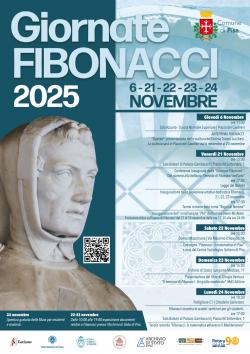
From 16 to 27 November, Pisa is celebrating one of its most illustrious sons, Leonardo Pisano, known as Fibonacci, with Fibonacci Day: his date of birth, 11-23, written in the Anglo-Saxon style, commemorates both his date of birth and the first four terms of the famous sequence in which each number is equal to the sum of the two preceding ones.
The programme kicks off from 16 to 22 November with Il coraggio di farsi domande (The Courage to Ask Questions), an exhibition tour for schools accompanied by games, puzzles and creative workshops throughout the week.
On Saturday 21 and Sunday 22 November, from 3.00 pm to 7.00 pm, the event will be open to the public at the former Church of Sant’Antonio in Qualquonia, offering families and visitors the chance to explore the exhibition at their leisure and take part in the activities on offer.
The weekend of 21 and 22 November will also feature the Mare Nostrum Choralis Festival, with concerts and a choral conference taking place at several significant venues across the city.
From 22 to 24 November, the State Archives of Pisa will host the documentary exhibition Leonardo di Guglielmo di Bonaccio, dedicated to Fibonacci’s ancestors through records preserved in historical parchments.
On 23 November, the Ludoteca Scientifica will host a lecture dedicated to Fibonacci, whilst from 23 to 27 November, the University of Pisa will run workshops for schools entitled ‘Mathematics to Understand the World, from Rabbits to Computers’, at the Museum of Calculating Instruments and the Ludoteca Scientifica.
Who was Leonardo Pisano
Leonardo Pisano, known as Fibonacci, was born in Pisa around 1175 and learned mathematics from his father, who was the representative of Pisan merchants in the port of Bejaia, Algeria. Here, the young Fibonacci was exposed to Arabic mathematics, geometry, and algebra, partly derived from Indian and Persian algebra, which at the time was more developed and thorough than European algebra. Fibonacci did not limit himself to learning the teachings of the great Arab mathematicians, but went further by developing his own theories in a fundamental book for the diffusion of mathematics in Western culture: the “Liber Abaci”, published in 1202. His statue is preserved in the Monumental Cemetery in Piazza dei Miracoli.
Info: Pisa Tourist Office
050.500100
www.pisa.turismo.it